India’s agricultural drone sector has grown rapidly under government initiatives such as the Kisan Drone scheme, Production Linked Incentive (PLI), and DGCA type certification requirements. Domestic manufacturers now supply the majority of certified platforms used for pesticide spraying, fertiliser application, seeding, and crop monitoring. These companies prioritise reliability in Indian field conditions, local service networks, and compliance with subsidy programmes.
Here are the top five Indian agricultural drone manufacturers based on market presence, DGCA certifications, deployment scale, and industry recognition as of 2026.The list is not a market-share ranking: India does not publish a single authoritative ranking of agricultural-drone OEM sales or fleet deployment. Instead, these companies were selected for their visible agricultural focus, publicly identifiable aircraft, and relevance to Indian spraying operations.
1. Garuda Aerospace
Founded in 2015 and headquartered in Chennai, Tamil Nadu, Garuda Aerospace is widely regarded as one of India’s largest and most visible agricultural drone companies. With strong financial backing and a widespread operational footprint, the company has played a pivotal role in the government's "Kisan Drone" initiatives. They focus on highly scalable, assembly-line manufacturing, producing drones that are accessible, easy to operate, and reliable for local farming communities. Garuda has publicly reported that its agricultural-drone fleet surpassed 2,000 units and accumulated 1 million flight hours in a year.
Representative Agricultural Drones
| Model | Rated payload | Published endurance |
| GA-AD | 8 kg | 7 minutes with full payload |
| GA-AD-V2 | 8 kg | 11 minutes 35 seconds; payload condition unspecified |
| GA-AD-M | 10 kg | 19 minutes; payload condition unspecified |
These platforms incorporate agricultural spraying systems, terrain-following sensors, and obstacle-detection features. The GA-AD-M provides the largest rated payload among the three listed models. The endurance figures need careful interpretation. Garuda explicitly identifies the GA-AD's seven-minute figure as a full-payload result. Its other two product pages do not provide the same qualification, so their longer figures should not automatically be interpreted as equivalent full-load improvements.
2. IoTechWorld Avigation
IoTechWorld Avigation, based in the Delhi NCR/Gurugram ecosystem, is a specialist Indian drone manufacturer active in agriculture, survey, surveillance, and enterprise UAV solutions. The company has a documented milestone in India's drone industry: on June 14, 2022, the Ministry of Civil Aviation announced that IoTechWorld had received the first Type Certificate issued under the Drone Rules, 2021.
Its agricultural portfolio centers on the Agribot family (Key models include the AGRIBOT A5, AGRIBOT A6, AGRIBOT MX, and AGRIBOT MX V1). IoTechWorld says its platform is designed for spraying, broadcasting and crop-health applications, while also providing fleet management and data logging capabilities. Its current product information lists configurations ranging from 10–40 litres for liquid payloads, depending on the model and configuration.
Representative Agricultural Drone
| Model | Spray tank / maximum payload | Published endurance | Maximum takeoff weight |
| AGRIBOT A6 | 10 L / 10 kg | Up to 20 minutes while dispensing payload | 24.88 kg |
| AGRIBOT MX | Liquid pesticides/fertilizers: 10–40 L; Granules/seeds: 10–30 kg | 15–30 minutes per battery | 10–50 kg |
IoTechWorld's published materials emphasize radar-based collision avoidance, terrain following, smart battery fail-safe functions and fleet-management tools. The company also highlights the A6's relatively compact design for transportation in rural environments.
The company's newer Agribot MX represents a more scalable platform. Depending on configuration, the manufacturer lists liquid payloads of 10–40 litres and granular or seed payloads of 10–30 kg, with approximately 15–30 minutes of flight time depending on payload and operating conditions.
3. Marut Drones
Marut Drones, operated by Marut Dronetech Pvt Ltd, is a Hyderabad-based drone company. Its co-founders include Prem Kumar Vislawath, Sai Kumar Chinthala, and Suraj Peddi. The company's activities extend across agriculture, healthcare logistics, public health, and environmental applications such as aerial seeding.
Agriculture is represented by its AG365 product family. Marut's broader emphasis on application development is relevant because agricultural drone work can involve more than liquid spraying. Different tasks may require granular spreading, seeding equipment, or crop-monitoring capabilities.
Its company background also includes engineering leadership with IIT Guwahati experience, alongside an emphasis on designing, manufacturing, and deploying drones for practical field applications.
Representative Agricultural Drone
| Model | Maximum payload / tank | Published flight time | Battery specification |
| AG 365S | 10 L | 30+ minutes on Marut’s product listing | 16,000mAh LiPo battery |
| AG 365 | 11 L | About 22 minutes | 22,000mAh LiPo battery |
| AG 365H | 11 L | About 23 minutes | 25,200mAh LiPo battery |
| AG 365XP | 10 L | 30+ minutes | 30,000mAh LiPo batteries |
| AG 3651 | 10 L | 30+ Minutes Flight Time | 30000 mAh Li-Po Batteries |
Marut positions the AG365H around transport convenience, including movement between farms on a two-wheeler. The AG365S emphasizes a compact format, while the AG365 family supports multiple agricultural applications with the appropriate configuration.
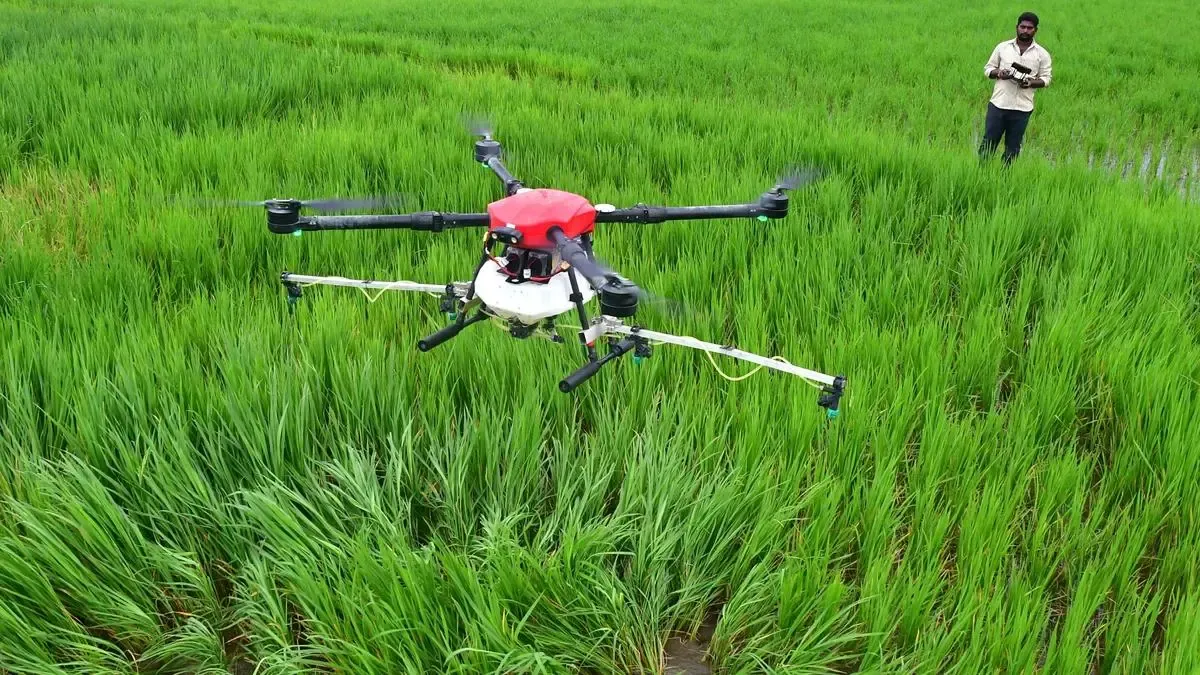
4. Dhaksha Unmanned Systems
Dhaksha Unmanned Systems has research roots in the Centre for Aerospace Research at Anna University-MIT. According to the company, its work began within that institution before it became an independent private limited company in April 2019.
Based in Chennai, Dhaksha provides capabilities spanning design, manufacturing, testing, training, and after-sales support. Its portfolio covers agriculture as well as defense and enterprise applications. The company also records Coromandel International's acquisition of a majority stake in 2023, connecting its drone business with an established agricultural inputs group.
A distinguishing feature of Dhaksha's agricultural portfolio is its inclusion of both battery-powered and engine-based hybrid aircraft. This gives buyers different propulsion approaches to evaluate against their field logistics and maintenance capabilities.
Representative Agricultural Drones
| Model | Published tank capacity | Published endurance | Propulsion |
| DH-AGRIGATOR-E10 | 10 L | 10 minutes with full payload | Battery |
| DH-AGRIGATOR-E10 PLUS | 10 L | 23 minutes; payload condition unspecified | Battery |
| DH-AG-H1 | 12 L | 35 minutes; payload condition unspecified | Hybrid, engine and battery |
Dhaksha is especially relevant where an operator wants to compare battery-electric versus hybrid agricultural UAV economics. For a battery-electric fleet, the essential commercial questions are battery pack quantity per aircraft, charging power, turnaround time, usable cycle life at local summer temperatures, spare battery pricing, and battery-service coverage—not just quoted flight time.
5. Thanos Technologies
Thanos Technologies traces its journey to 2016. Its co-founders, Pradeep Palelli and Prathyush Akepati, lead the company's business and technical activities. Thanos describes in-house drone design and manufacturing capabilities, supported by experience in spraying services, custom aircraft development, and repairs.
Agricultural spraying is a clear focus of its SYENA range. The company's background in both hardware development and field services provides useful context for its emphasis on transportability, maintenance, and repeated spraying operations. These are relevant considerations for agricultural service businesses that must keep aircraft working across multiple farms.
Representative Agricultural Drones
| Model | Payload limit | Published maximum endurance | Maximum all-up weight |
| SYENA-H10 | 10 L or 10 kg, whichever is less | 18.28 minutes | 29.4 kg |
| SYENA-H10i | 10 L or 10 kg, whichever is less | 22 minutes | 30.3 kg |
Both aircraft use a hexacopter configuration and offer manual, semi-autonomous, and autonomous flight modes. Their published spray width is three to five meters. The H10i additionally lists radar obstacle-avoidance sensors, a live video camera, and a controller with an integrated screen.
Other Agricultural Drone Manufacturers and Suppliers Worth Watching
General Aeronautics
General Aeronautics is a Bengaluru-based aerospace technology company founded by a team with substantial aircraft-engineering experience. Its flagship agricultural platform is the Krishak family. The company's current agricultural platform emphasizes variable-rate spraying, droplet control, autonomous mission management and crop-science integration. The company lists 70–350 micron droplet control, 500+ battery cycles and up to 100 acres/day among the platform's performance highlights.
The newer Krishak 1i has also received DGCA type certification. Its certification data specifies a 10-litre spray tank, 22-minute endurance, 1.5 km range and 25,200 mAh battery.
Kisan Drones
There is an important naming issue here. Kisan Drones Private Limited, associated with Raminfo, should not be confused with the generic Indian term "Kisan Drone" used by multiple manufacturers.
Raminfo announced Kisan Drones in 2024 as a Drone-as-a-Service platform, with a focus on field mapping, fertilizer spraying and crop monitoring rather than simply selling a standalone drone platform. Kisan Drones Private Limited was incorporated in Hyderabad in 2023, and Raminfo has reported an equity investment in the company.
This makes Kisan Drones worth watching from a drone-service and agricultural deployment perspective, although it is better classified as an AgriTech/DaaS business than as a traditional UAV OEM.
| Listed product package | Published tank capacity | Battery |
| X8 Drone Combo 1, Hexa | 8 L | 6s 22000mah |
| X8 Drone Combo 2, Hexa | 8 L | 14s 22000mah |
| 20L Drone Combo, Quad | 20 L | 14s 30Ah |
| 30L Drone Combo, Quad | 30 L | 14s 30Ah |
How to Compare Agricultural Drone Specifications?
First, tank volume and payload weight measure different things. A tank's capacity in liters describes volume, while a kilogram limit describes allowable mass. The intended liquid must fit within both limits.
Second, flight-time conditions matter. Full-payload endurance, endurance while spraying, and an unspecified maximum flight time are different measurements. Request the starting payload, battery configuration, landing reserve, and test conditions before using them in a purchasing comparison.
Third, daily output includes ground operations. Refilling, battery changes, charging, travel between plots, and maintenance all affect completed acreage. A field demonstration should include these activities and use the planned spray volume.
For a practical shortlist, request the exact model documentation, a representative demonstration, and a written breakdown of the supplied equipment and support. This creates a stronger comparison than selecting the longest advertised flight time.
Frequently Asked Questions
Which five agricultural drone manufacturers are covered here?
Garuda Aerospace, IoTechWorld Avigation, Marut Drones, Dhaksha Unmanned Systems, and Thanos Technologies form this article's main shortlist.
What payload sizes are common among these drones?
Most featured platforms list approximately 8-12 liters of liquid capacity or 8-10 kg of payload. Kisan Drones also advertises 20-liter and 30-liter packages.
Are the published flight times directly comparable?
No. Some specify full payload, others describe spraying operations, and several omit the load condition. Comparable testing is needed to judge endurance fairly.
Does a larger tank guarantee higher daily productivity?
No. Useful output also depends on application rate, field layout, refill time, energy availability, and the ability to sustain repeated operations.
Small-Scale Operations (8L-10L/11L–16L)
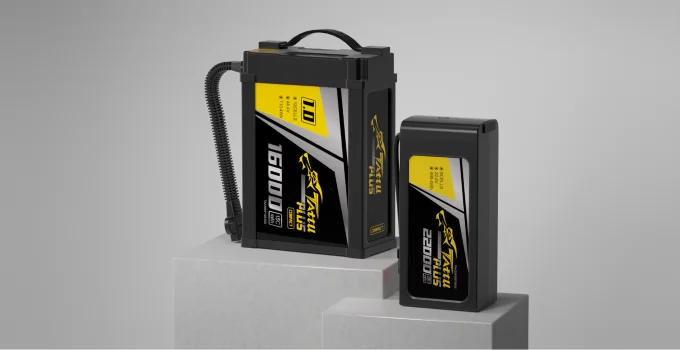
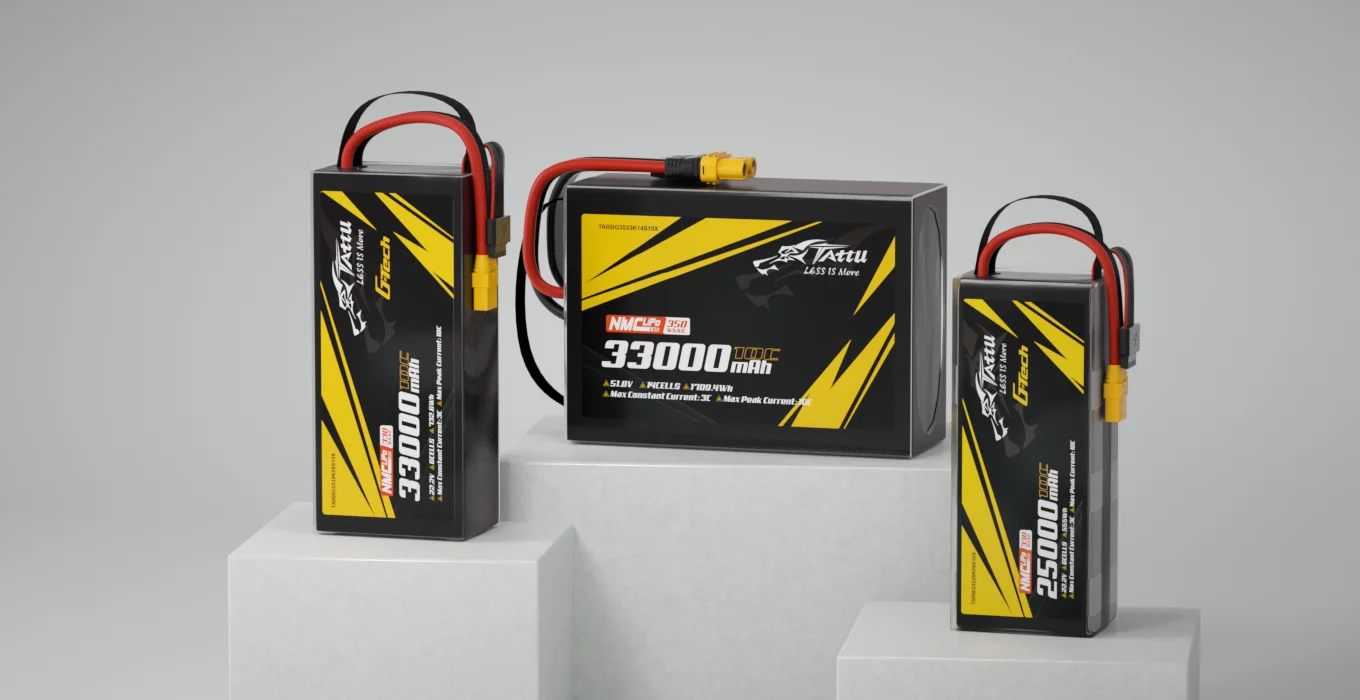
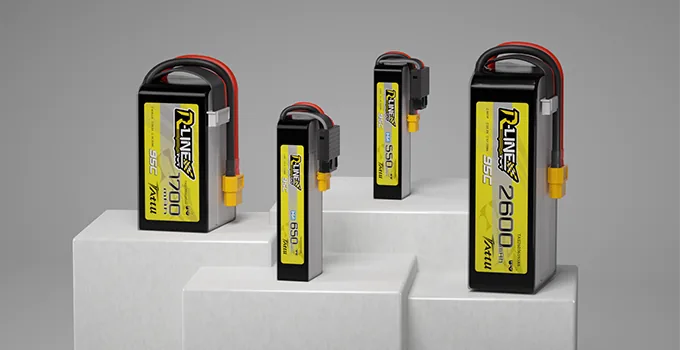
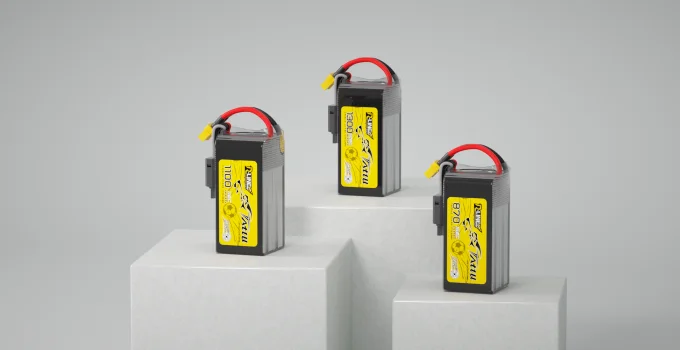
Tattu Classic 16000mAh 6S1P 22.2V Battery for 8L/10L Agriculture Spraying Drone
Tattu Classic 22000mAh 6S1P 22.2V Battery for 8L/10L Agriculture Spraying Drone
Tattu Classic 25000mAh 6S1P 22.8V Battery for 8L/10L Agriculture Spraying Drone
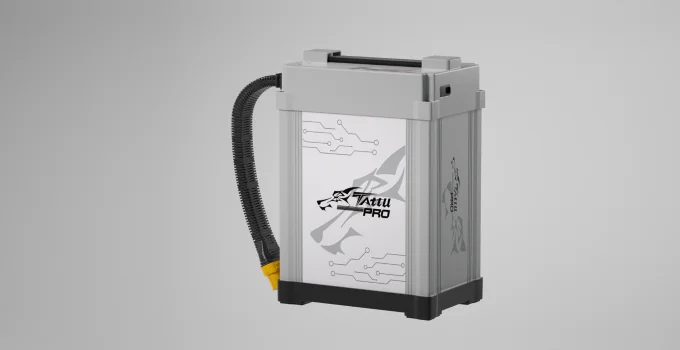
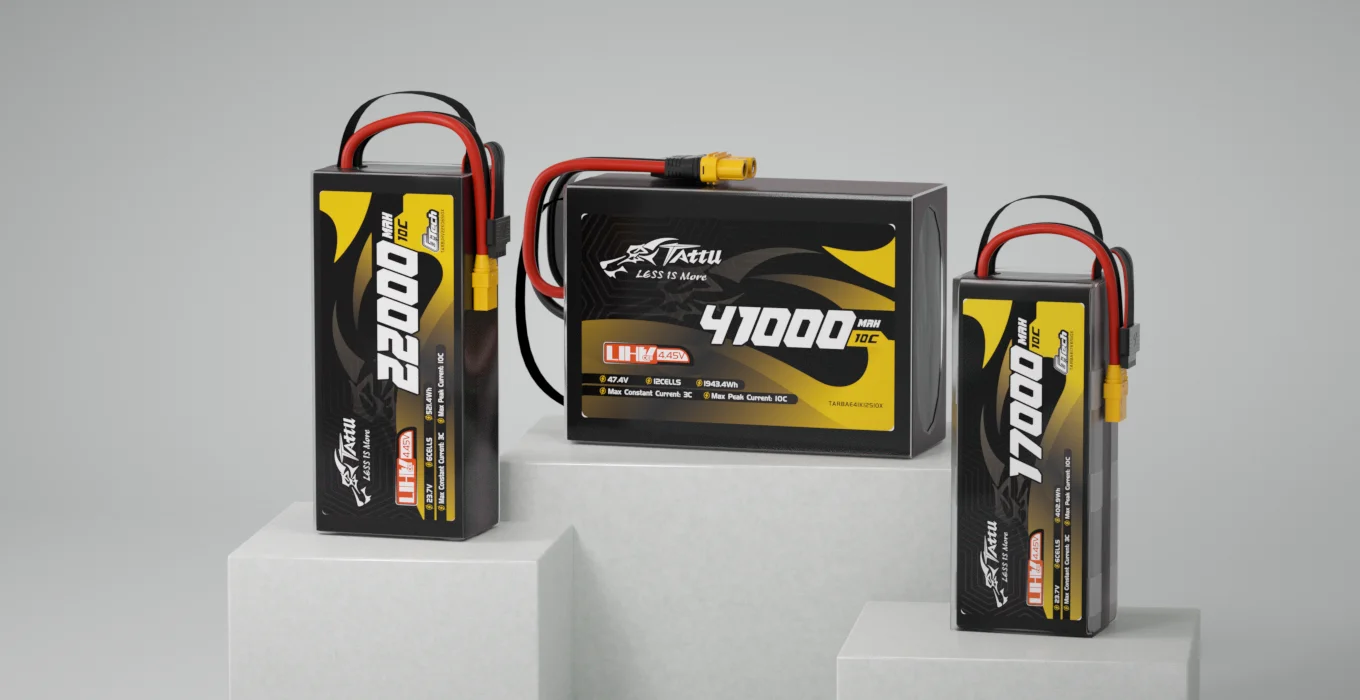
Tattu Pro 12S 16000mAh Battery for 10L Agriculture Spraying Drone
Tattu Pro 12S 22000mAh Battery for 16L Agriculture Spraying Drone
Mid-Size Commercial Fleets (20L–30L)
Tattu Pro 14S 22000mAh Battery for 20L Agriculture Spraying Drone
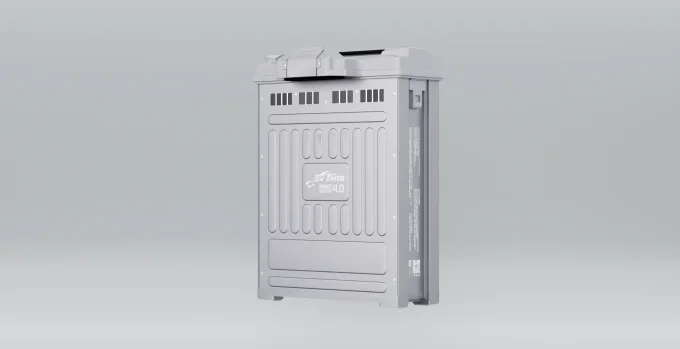
Tattu 4.0 14S 20000mAh Battery for 20L Agriculture Spraying Drone
Tattu 4.0 14S 30000mAh Battery for 30L Agriculture Spraying Drone








 Blog
Blog
 Blog
Blog
 Blog
Blog


