Choosing the right UAV battery involves more than comparing capacity or
voltage. Different flight missions place different demands on a battery. Some
platforms require high discharge capability to handle demanding takeoffs, rapid
climbs, and changing payload conditions, while others prioritize greater energy
capacity to support longer flight missions.
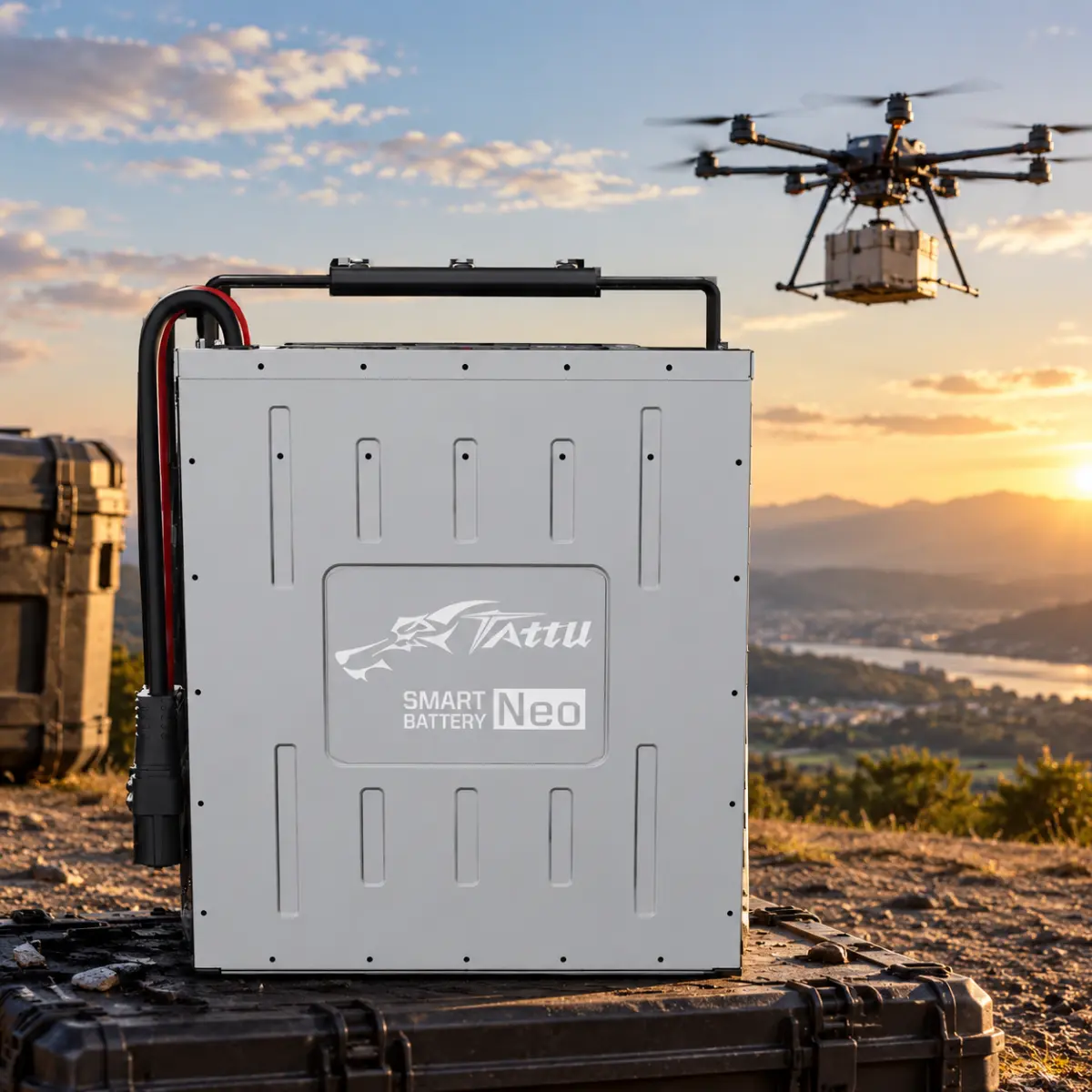
The Tattu NEO Smart Battery series offers 18S and 24S configurations with
two distinct performance orientations: High Power and High Energy Density. But
what do these differences mean in actual UAV operation? Does a higher C-rate
always indicate better performance? Is a 60Ah battery necessarily a better
choice than a 30Ah battery?
This guide compares the specifications of four Tattu NEO battery
configurations, explains how their electrical characteristics translate into
practical performance, and helps UAV operators identify the right battery for
their platforms and mission requirements.
1. Understanding 18S vs. 24S: Start with System Voltage
Before comparing battery capacity or discharge performance, the first step
is to identify the voltage requirements of your UAV propulsion system. In
battery terminology, S represents the number of cells connected in series, while
P represents the number of parallel cell groups.
·Series configuration (S): Determines the battery's nominal voltage.
·Parallel configuration (P): Increases overall capacity and influences the
battery's current capability, depending on cell design.
The Tattu NEO series includes both 18S and 24S configurations. The 24S
configurations operate at a higher nominal voltage than the 18S configurations.
However, this does not automatically make a 24S battery the better choice.
The battery must match the voltage range supported by the UAV's motors,
ESCs, power distribution system, and other electrical components. The nominal
voltage figures above also reflect different cell nominal voltages, so batteries
with the same S count may not have identical nominal voltages.
2. Comparing Tattu 24S NEO Batteries: High Power vs. High Energy
Density
The 24S NEO series offers two configurations with different performance
priorities.
| Specification | 30,000mAh | 60,000mAh |
|---|
| Configuration | 24S1P | 24S2P |
| Nominal Voltage | 91.2V | 88.8V |
| Nominal Energy | 2,736Wh | 5,328Wh |
| Weight | 17,000 ± 200g | 21,000 ± 200g |
| Standard Charge Current | 15A (0.5C) | 30A (0.5C) |
| Max. Continuous Charge | 90A (3C) | 60A (1C) |
| Max. Continuous Discharge | 165A (5.5C) | 180A (3C) |
| Peak Discharge Current | 520A (17.3C) | 265A (4.4C) |
| Performance Focus | High Power | High Energy Density |
The 24S 30,000mAh High Power pack is the performance-oriented option.
Despite its lower capacity, it delivers 165A continuously and 520A at peak—far
beyond the 60,000mAh version’s 180A continuous and 265A peak ratings. That makes
it better suited to aircraft with high instantaneous power demand, strong
acceleration requirements, or safety margin needs during gusty conditions.
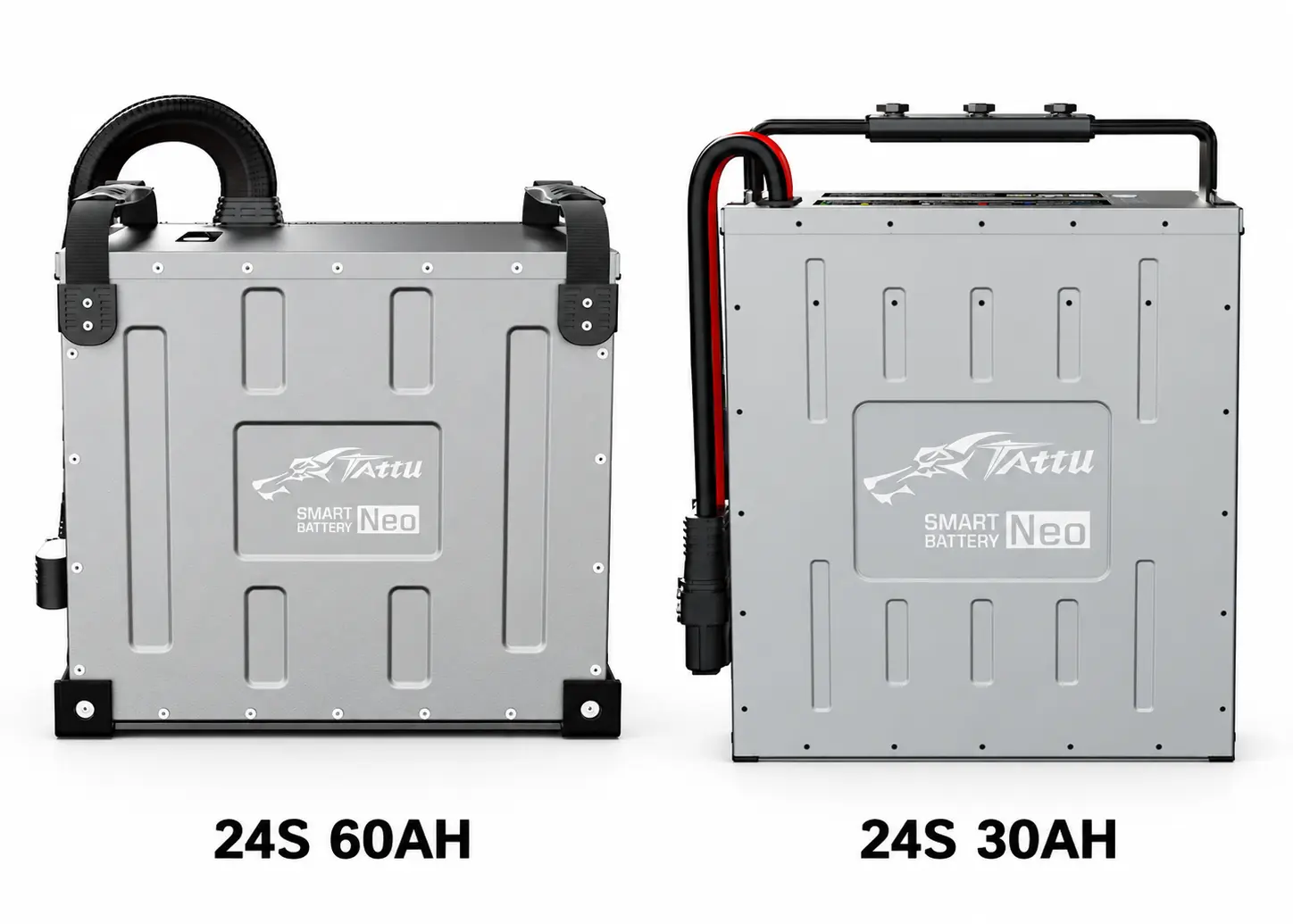
The 24S 60,000mAh High Energy Density pack doubles the capacity and adds a
second parallel cell group. It weighs about 4kg more, but its substantially
higher energy reserve makes it the better choice for long-range inspection,
mapping, cargo delivery, and other missions where the aircraft can maintain a
moderate, efficient discharge profile.
3. Comparing Tattu 18S NEO Batteries: High Power vs. High Energy
Density
The 18S NEO series offers another interesting comparison. Unlike the 24S
configurations, the two 18S batteries have similar absolute discharge-current
capabilities despite their different capacities and C-rates.
| Specification | 41,000mAh | 60,000mAh |
|---|
| Configuration | 18S2P | 18S2P |
| Nominal Voltage | 68.4V | 66.6V |
| Nominal Energy | 2,804.4Wh | 3,996Wh |
| Weight | 16,200 ± 400g | 15,900 ± 350g |
| Standard Charge Current | 8.2A (0.2C) | 12A (0.2C) |
| Max. Continuous Charge | 120A (3C) | 60A (1C) |
| Max. Continuous Discharge | 180A (4.4C) | 3C (approx. 180A) |
| Peak Discharge Current | 240A (6C) | 4C (approx. 240A) |
| Performance Focus | High Power | High Energy Density |
The 18S 41,000mAh High Power pack offers a clear performance advantage:
180A continuous discharge and 240A peak discharge, compared with 3C and 4C
ratings for the 60,000mAh High Energy Density pack. It is therefore the stronger
option for drones that need reliable power headroom rather than maximum
endurance.
The 18S 60,000mAh High Energy Density pack provides nearly 46% more
capacity while weighing only about 300g less than the 41,000mAh High Power
version. For endurance-focused platforms, that difference can translate into
longer loiter time, greater route coverage, or more payload flexibility—provided
the drone’s average current draw remains within the pack’s lower discharge
envelope.
4. High Power vs. High Energy Density: Design Philosophy & Cell
Chemistry
The fundamental distinction between High Power (HP) and High Energy Density
(HED) formulations lies in the internal structure of the battery
cells—specifically anode/cathode thickness, separator porosity, tab
construction, and electrolyte conductivity.
1. High Power (HP) Formulation
·Focus: Extreme current delivery, thermal stability during rapid bursts,
and ultra-fast charging turnarounds.
·Cell Architecture: Employs thinner electrode coatings with larger active
surface areas and multi-tab cell designs. This significantly reduces internal
resistance, enabling high C-rate discharges without causing severe thermal
runaway or excessive voltage sag.
·Higher Nominal Voltage: The HP series utilizes a 3.8V per cell nominal
voltage platform (compared to standard 3.7V), providing higher initial voltage
levels to reduce overall current draw for equivalent power demands.
2. High Energy Density (HED) Formulation
·Focus: Maximum stored energy (Wh) per unit of mass (kg), delivering
maximum flight endurance for long-range missions.
·Cell Architecture: Maximizes the volume of active electrochemical
material (nickel-rich cathodes and dense graphite/silicon anodes) while
minimizing current collector foil thickness.
·Gravimetric Advantage: Yields energy densities exceeding 250 Wh/kg,
significantly higher than the approx 160-173Wh/kg found in high-power
chemistry.
5. High Power vs. High Energy Density: What Is the Real Difference?
Translating raw technical specifications into field performance highlights
critical operational differences:
1. Gravimetric Energy Density (Wh/kg) and Payload Efficiency
The total electrical energy stored in a battery is calculated as: Energy Density = Energy/Weight
·24S HED (60,000 mAh): Stored Energy= 88.8 V x 60 Ah = 5, 328 Wh. At 21.0
kg, this equals253.7 Wh/kg.
·24S HP (30,000 mAh): Stored Energy= 91.2 V x 30 Ah = 2, 736 Wh. At 17.0
kg, this equals160.9 Wh/kg.
Dperational lmpact:
The 24S HED packs nearly double the total stored energy (5, 328 Wh vs. 2,
736 Wh) with only a 23.5% weight increase (21 kg vs. 17 kg). For long-endurance
mapping or steady-state transport drones, the HED formulationdramatically
increases total hover and cruise time.
2. Peak & Continuous Discharge Capabilities
During sudden flight maneuvers, emergency climbouts, heavy wind resistance,
or high payload accelerations, the propulsion system demands instantaneous
bursts of power.
·24S HP Burst Power: Capable of delivering a 520A peak pulse (17.3c),
equivalent to over 47 kW of instantaneou electrical power(520 A x91.2 V).
·24S HED Burst Power: Capped at a 265A peak pulse (4.4C), yielding around
23.5 kW.
Operational Impact: If a heavy-lift drone carrying a full 100kg payload
attempts an aggressive altitude correction using HED batteries, the cells may
experience severe voltage sag, trigger low-voltage alarms, or exceed thermal
safety thresholds. The HP formulation handles high instantaneous loads smoothly
without significant voltage degradation.
3. Fast-Charging Capabilities & Fleet Operational Efficiency
Turnaround time on the ground directly dictates fleet productivity,
especially in agricultural spraying and emergency logistics.
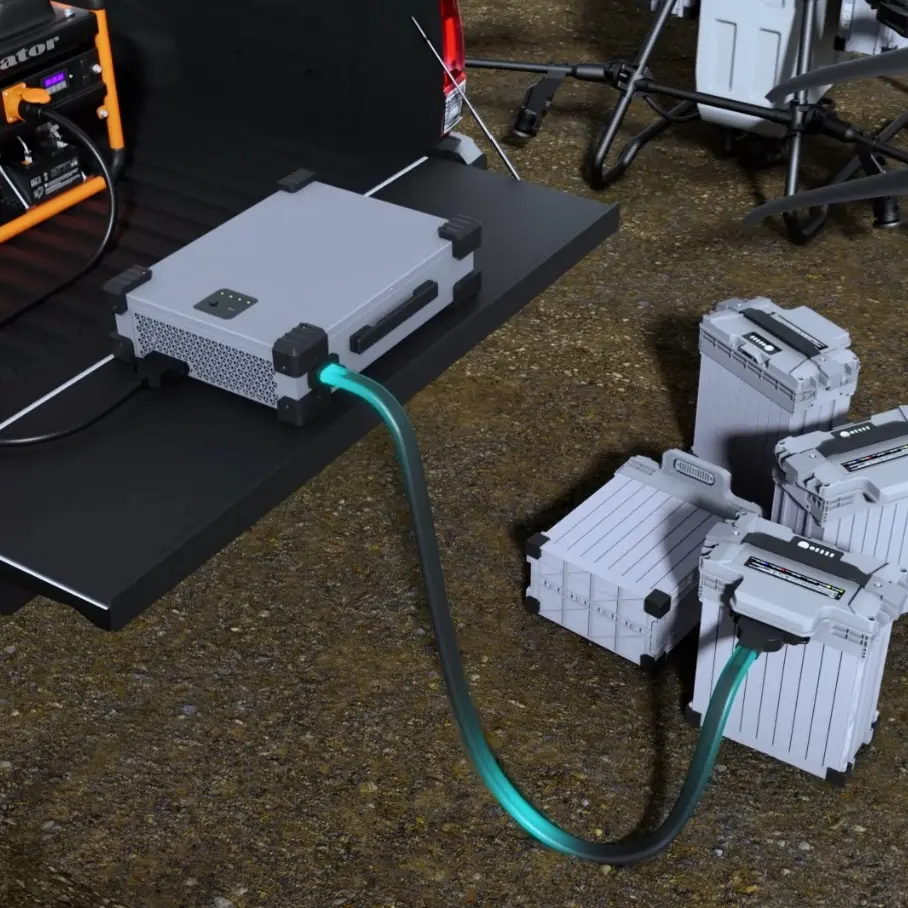
·High Power (HP): Supports up to 3C fast charging (e.g., 90A for 24S HP;
120A for 18S HP). A full charge cycle from20% to 90% SOC can be completed in
roughly 12 to 15 minutes.
·High Energy Density (HED): Limited to 1C maximum charge current (60A).
Charging requires approximately 45to 60 minutes to safely reach full capacity
without causing lithium plating.
Operational Impact: Using HP batteries allows commercial operators to
maintain continuous multi-drone rotations with fewer overall battery sets per
field charger. HED batteries require larger battery reserves on-site if rapid
turnaround times are required.
6. Which Drone Applications Fit Each Type?
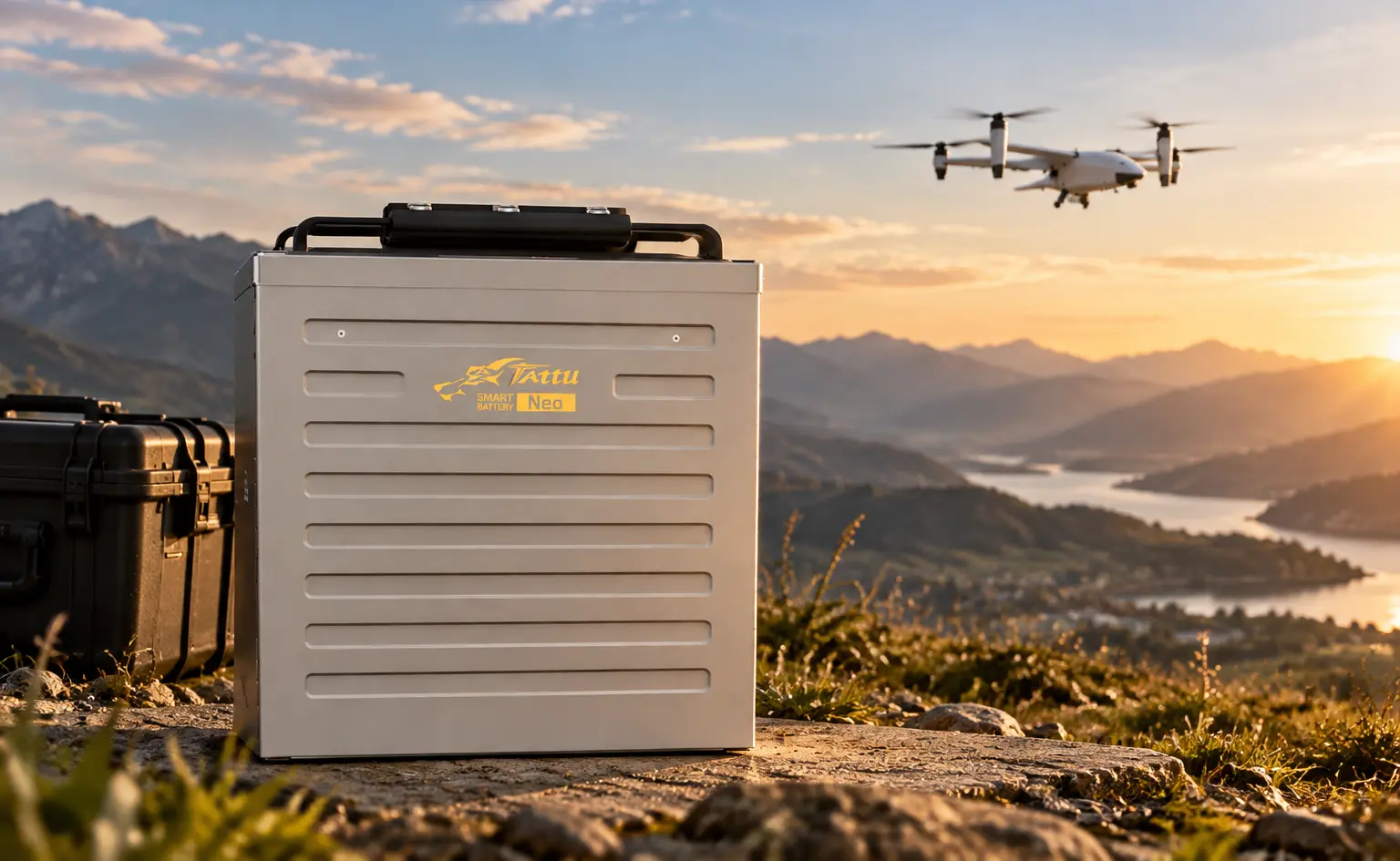
Choose High Power UAV battery when the mission demands responsiveness
High Power NEO packs are best for platforms where motor current can spike
or remain high:
·Heavy-lift multirotors and industrial drones carrying substantial
payloads
·Aircraft operating in wind, at high altitude, or in conditions requiring
rapid throttle response
·VTOL or hybrid platforms with high-power transition phases
·Missions where burst performance and continuous power margin are more
important than absolute flight time
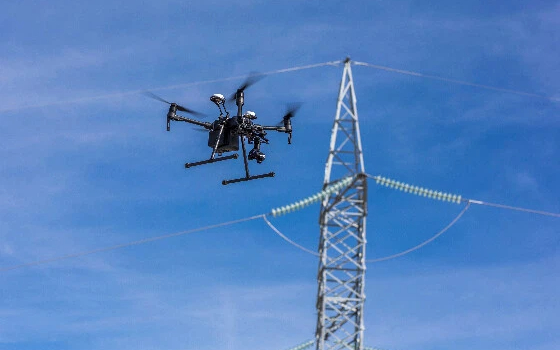
For example, a heavy industrial inspection drone that must climb quickly
with sensors, lights, or delivery hardware will benefit more from the 24S
30,000mAh or 18S 41,000mAh High Power packs. Their higher continuous and peak
current ratings give the propulsion system more room to operate safely under
load.
Choose High Energy Density UAV battery when endurance drives value
·High Energy Density NEO packs are best for steady, long-duration
operations:
·Long-range mapping, surveying, and corridor inspection
·Surveillance, patrol, and perimeter monitoring
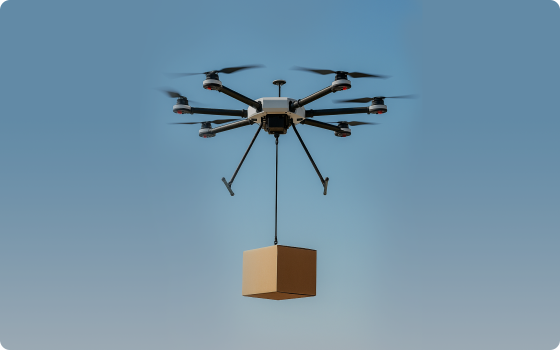
·Cargo delivery routes with predictable cruise power
·Any aircraft where every additional minute of endurance improves mission
economics
For example, a fixed-wing VTOL conducting a long linear infrastructure
inspection may be better served by the 24S 60,000mAh or 18S 60,000mAh High
Energy Density packs. Their larger capacity supports longer flight times, while
the lower discharge requirement matches a stable cruise profile.
7. Frequently Asked Questions
Q1: Does a 24S UAV battery always provide more power than an 18S
battery?
Not necessarily. A 24S battery has a higher nominal voltage than an 18S
battery in the configurations compared here, but actual power output depends on
both voltage and current. The motor, ESC, battery discharge capability, and
overall propulsion system determine the available power.
Q2: Does a 60Ah battery provide twice the flight time of a 30Ah
battery?
No. Although a 60Ah battery has twice the rated capacity of a 30Ah battery
at the same nominal voltage, actual flight time also depends on battery weight,
aircraft power consumption, payload, flight conditions, and usable energy.
Q3: Is a higher C-rate always better for UAV applications?
No. A higher C-rate indicates a greater current capability relative to
battery capacity, but it does not necessarily mean higher absolute discharge
current. Choose a C-rate and current rating that match your UAV's actual
electrical requirements.
Q4: Should I choose a high-power battery for every heavy-lift UAV?
Not necessarily. Heavy-lift UAVs can have demanding peak-current
requirements during takeoff and climbing, but some missions prioritize sustained
operation and longer endurance. The correct choice depends on the aircraft's
actual current profile and mission energy requirements.
Q5: Can I use an 18S battery on a 24S UAV platform?
No, unless the complete electrical system is specifically designed and
approved for that battery configuration. The battery's series count and voltage
range must match the propulsion and power management systems.
Conclusion
Choosing between high power and high energy density is ultimately about
understanding what your UAV needs most. The Tattu NEO 18S and 24S series provide
different combinations of capacity, discharge capability, charging current, and
weight to address different UAV power requirements.
If your priority is demanding discharge performance, higher C-rates, or
greater peak current capability, consider the High Power configurations. If your
priority is greater onboard energy and longer mission endurance, the High Energy
Density configurations may be more suitable, provided their discharge ratings
meet your platform's requirements.
Most importantly, start with your UAV's voltage and current requirements,
then evaluate capacity and weight against the intended mission.The right battery
is not necessarily the one with the largest capacity or highest C-rate. It is
the one that delivers the appropriate balance of power, energy, and weight for
your aircraft.For any further inquiries, please feel free to contact us at [email protected].










 Blog
 Blog
 Blog


