A drone battery's configuration affects its voltage, capacity, current
output, weight, and overall performance. Two common terms used to describe
battery configurations are series (S) and parallel (P). They appear in
specifications such as 6S1P, 6S2P, and 12S2P.
Although these terms may look technical, the basic principles are
straightforward. Connecting cells in series increases voltage, while connecting
them in parallel increases capacity in amp-hours (Ah). Many drone batteries
combine both methods to meet the electrical and power requirements of an
aircraft.
Understanding these configurations is useful when selecting a drone
battery, comparing different battery designs, or developing a power system for a
new UAV platform. One important distinction should be made from the start: S and
P labels usually describe how individual cells are connected inside a battery
pack. They do not automatically tell you how multiple complete battery packs are
connected to the drone.
1. What is Series Connection?
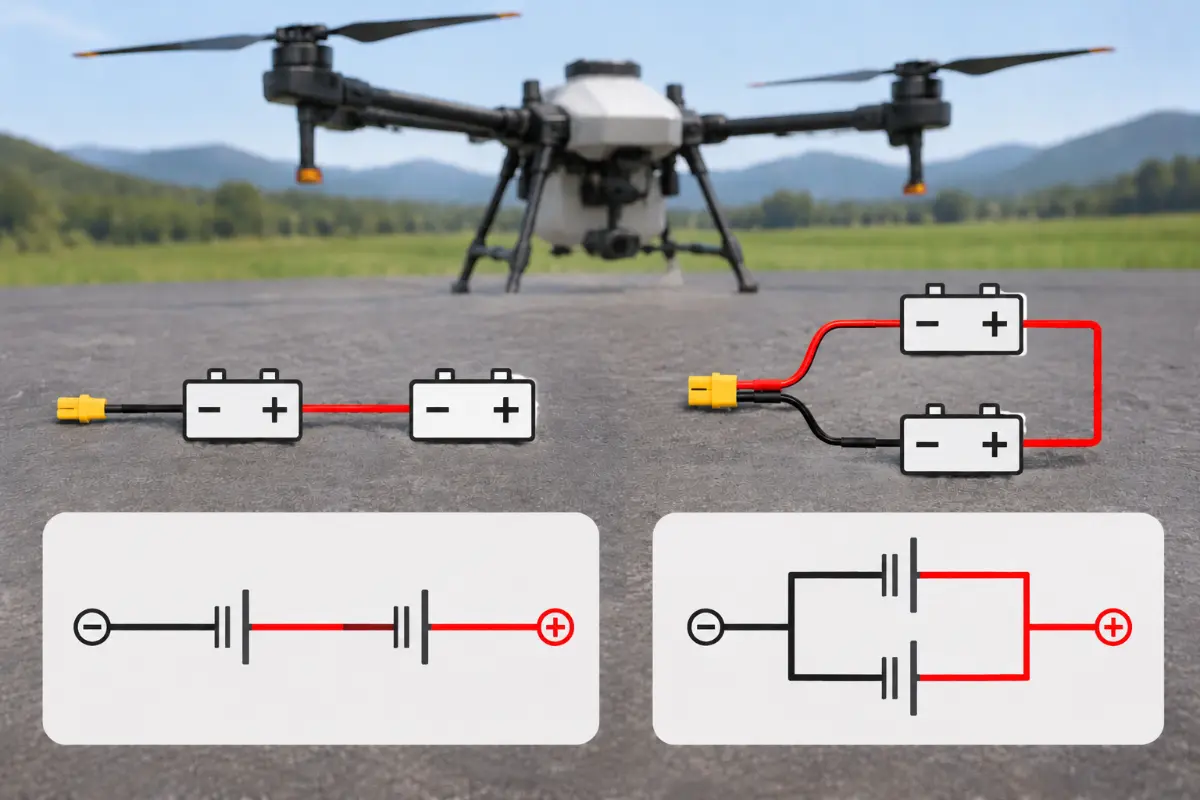
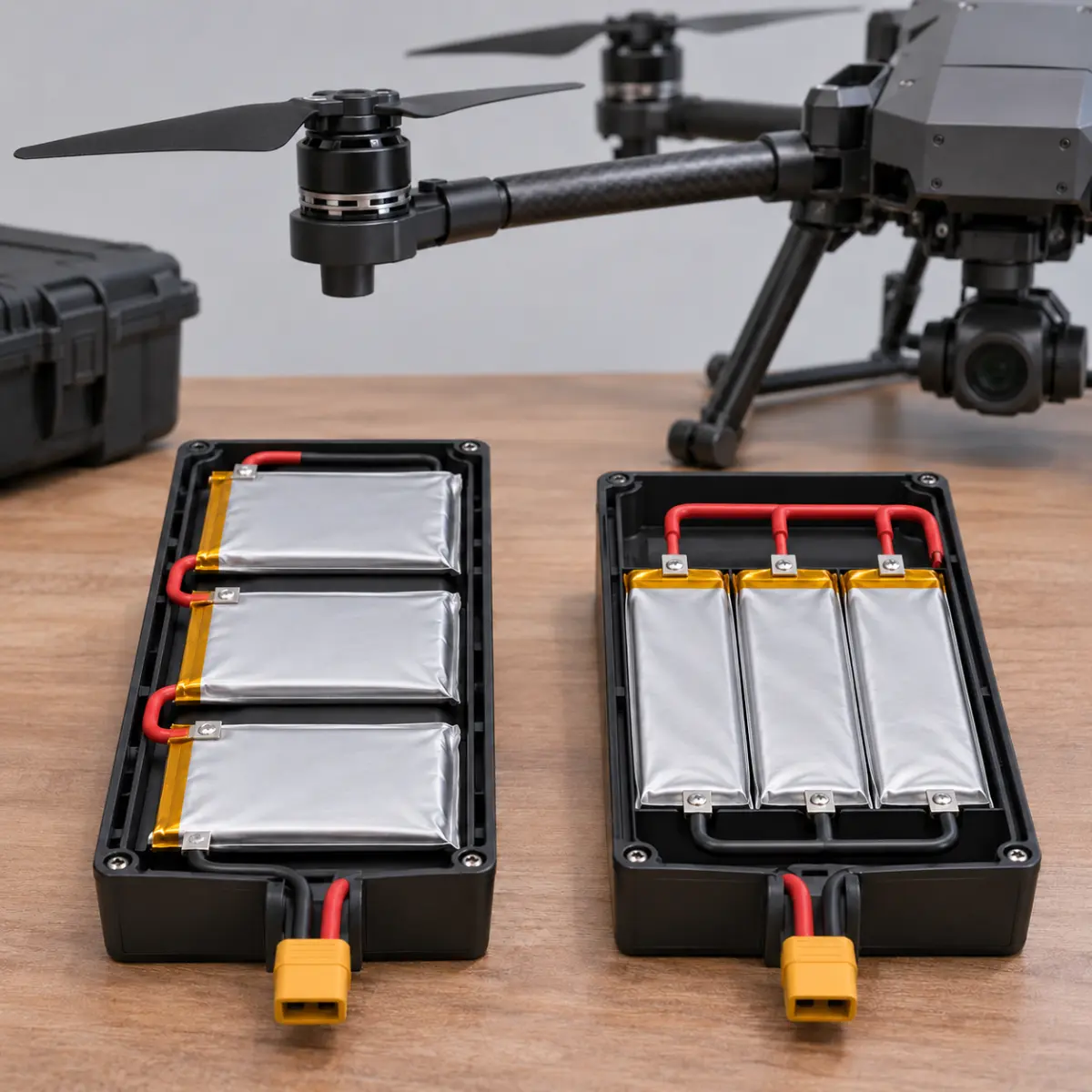
In a series connection, cells are joined end to end: the positive terminal
of one cell connects to the negative terminal of the next. This adds the cell
voltages together, while the capacity in amp-hours (Ah or mAh) stays the same as
one cell.
For example, if one lithium cell has a nominal voltage of about 3.7V and a
capacity of 8000mAh:
·2 cells in series = 2S, about 7.4V nominal, 8000mAh
·6 cells in series = 6S, about 22.2V nominal, 8000mAh
The total energy rises because voltage rises, even though the Ah figure
does not. Drones use series connections because motors, electronic speed
controllers (ESCs), and power systems need a particular working voltage. A
higher-voltage pack can deliver the same power with less current, which helps
reduce heat and voltage sag during demanding flight.
2. What is parallel Connection?
In a parallel connection, all positive terminals are connected together,
and all negative terminals are connected together. The voltage stays the same as
one cell, but the capacities add together.
Using the same 3.7V, 8000mAh cell:
·2 cells in parallel = 2P, about 3.7V nominal, 16000mAh
·4 cells in parallel = 4P, about 3.7V nominal, 32000mAh
Parallel groups also share the load. If each cell can safely provide a
certain discharge current, two cells in parallel can generally provide about
twice that current, assuming the cells and connections are properly matched.
However, current does not always divide equally between parallel cells.
Differences in internal resistance, temperature, cell condition, and wiring can
affect how much current each cell supplies.
3. What Does a 6S2P 16,000mAh Drone Battery Mean?
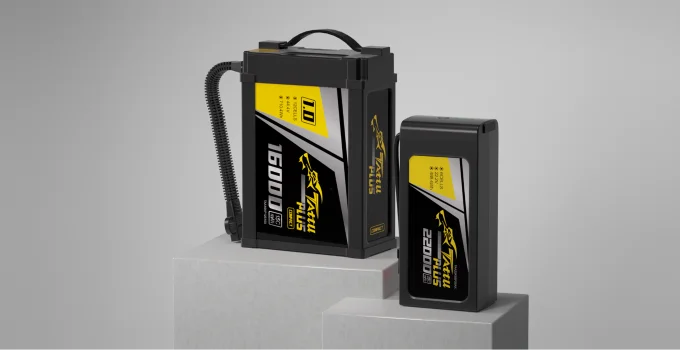
Let's decode a common enterprise drone battery specification: 6S2P
16000mAh.
·6S (Series): There are 6 groups of cells connected in series to boost the
total voltage. (Nominal voltage=6x3.7V=22.2V;fully charged voltage =6 x 4.2V =
25.2V).
·2P (Parallel): Each of those 6 groups actually consists of 2 smaller
individual cells wired inparallel.
·Total Cell Count: To find the total number of individual cells inside the
battery pack, you multiply the series number by the parallel number: 12 cells (6
x 2)
·Where does 16000mAh come from: If each individual cell in the parallel
pair has acapacity of 8000mAh, wiring two of them in parallel doubles the
capacity (8000mAh x2=16000mAh).
| Configuration | Nominal voltage | Capacity | Cell count |
| 1 cell | About 3.7V | 8000mAh | 1 |
| 6S1P | About 22.2V | 8000mAh | 6 |
| 6S2P | About 22.2V | 16000mAh | 12 |
4. Why Do Some Batteries Use 1P While Others Use Multi-P for the Same
Capacity?
For a fixed total capacity, a manufacturer can build it as one large cell
per series position (1P) or as several smaller cells in parallel (multi-P). Each
design choice comes with specific trade-offs:
Using 1P (Fewer, Larger Cells)
Pros:
·Simpler internal structure and fewer weld points, which lowers
manufacturing complexity.
·Slightly lighter packaging weight because fewer separation materials,
tapes, and outer wraps are needed.
Cons:
·Limited discharge capability. A single large cell may struggle to deliver
the high continuous current (high C-rating) required by heavy-duty motors unless
it is an extremely advanced cell type.
·If that single cell degrades or fails, a larger portion of the system is
impacted.
Using Multi-P (Multiple Smaller Cells in Parallel)
Pros:
·Lower Internal Resistance (IR): Parallel paths allow electrical current
to flow more easily, reducing internal heat generation during high-power
discharges.
·Higher Burst Current: Essential for demanding applications like
heavy-lift enterprise drones and 50L-class agricultural drones that require
massive power surges during takeoff and directional changes.
·Better Thermal Dissipation: Smaller cells have a higher
surface-area-to-volume ratio, helping the battery stay cooler under heavy
loads.
Cons:
·More complex assembly process requiring precise spot-welding of multiple
cells.
·Slightly higher passive weight due to extra nickel strips and insulation
materials.
What Determines the Right Configuration?
Battery manufacturers consider several factors when choosing between 1P and
multi-P designs:
·Cell availability: Whether suitable high-capacity cells are available for
a 1P design or smaller cells are more practical.
·Discharge requirements: The continuous and peak current required by the
drone.
·Weight and space: The battery compartment, available installation space,
and overall weight limit.
·Thermal performance: Heat generation, heat transfer, and temperature
differences between cells.
·Manufacturing and reliability: Cell consistency, connection quality,
protection design, and production control.
In practice, the best configuration is determined by the complete battery
design, not simply by whether it has more parallel cells.
5. In Actual Drone Applications, Are Multi-Battery Packs Connected in
Series or Parallel?
When operating professional drones—such as agricultural spraying drones or
industrial inspection UAVs—operators often use dual-battery setups to extend
working time. How are these external packs connected to the drone? They are
connected in Parallel.
The Engineering Reason: Electronic Speed Controllers (ESCs) and flight
controllers on drones are rated for specific maximum voltages (e.g., 12S or 14S
systems). If you connected two battery packs in series, you would double the
system voltage (turning a 14S system into a 28S system), which would instantly
fry the electronic components and motors.
By connecting two identical battery packs in parallel (using a safe
parallel discharge board or dual-input power module), the system voltage remains
safe and stable (e.g., staying at 14S), while the total energy pool and usable
operating time are doubled. This ensures high reliability, steady power
delivery, and safety in the field.
However, in practical use, there are also cases involving series
connections. The Watts Innovations PRISM industrial multirotor provides a clear
example of this design. According to its flight manual, PRISM operates on a 12S
power system and supports either:
·Two 12S LiPo battery packs.
·Four 6S LiPo battery packs.
For the four-battery option, the manufacturer specifies the use of
dedicated 6S-to-12S power plates. These connect two 6S batteries in series to
create a 12S supply. The manual also describes the two 12S flight packs feeding
a central power distribution board. Separate current sensors measure the current
from each pack, while the system measures their voltage together.
6. Important Considerations When Connecting Multiple Drone Batteries
Although series and parallel connections provide useful design flexibility,
incorrect battery matching can create serious electrical and safety problems.
Before using multiple battery packs in one aircraft, several factors must be
considered:
·Voltage compatibility: Batteries must have the correct series count and
voltage for the aircraft.
·Capacity and discharge capability: Packs should have compatible
specifications and be able to meet the required current.
·State of charge: Batteries connected in parallel must have closely
matched voltages before connection. A large voltage difference can cause a high
equalization current.
·Battery condition: Packs should have similar age, health, internal
resistance, and operating history.
·Power management: The power distribution system, connectors, wiring, and
protection devices must be designed for the combined electrical load.
Battery manufacturers and aircraft manufacturers may also specify
additional requirements for charging, installation, and battery pairing. Always
follow the aircraft manufacturer's approved battery configuration. Do not
connect separate battery packs in series or parallel simply because their
connectors fit.
Conclusion
Series and parallel connections serve different purposes in drone battery
design. A series connection increases voltage, while a parallel connection
increases capacity in Ah. By combining both methods, manufacturers can build
battery packs that meet different voltage, capacity, and discharge requirements.
The choice between 1P and multi-P depends on cell availability, discharge
requirements, weight, space, thermal performance, and manufacturing
considerations. More parallel cells do not automatically mean better battery
performance.
At the aircraft level, multiple complete battery packs may be connected in
parallel, in series, or through a more complex power-management system. The
correct choice depends on the drone's voltage platform and overall power
architecture. Understanding these differences makes it easier to compare battery
specifications, select the right configuration, and design a power system that
meets the actual requirements of a UAV.
As a global leading drone battery
supplier, Tattu offers ultra-high C-rate FPV batteries and high-energy-density
semi-solid-state UAV batteries ranging from 1S to 24S. In addition, battery
packs with any series and parallel configuration can be customized to meet
specific customer requirements. If you have any questions or project inquiries,
please contact us at [email protected].









 Blog
 Blog
 Blog


